
AC Leaking Water?
Here's Why, by Unit Type
Central, window, portable, or a furnace sharing the same drain line — the cause is different for each, and so is the fix. Find your unit below.
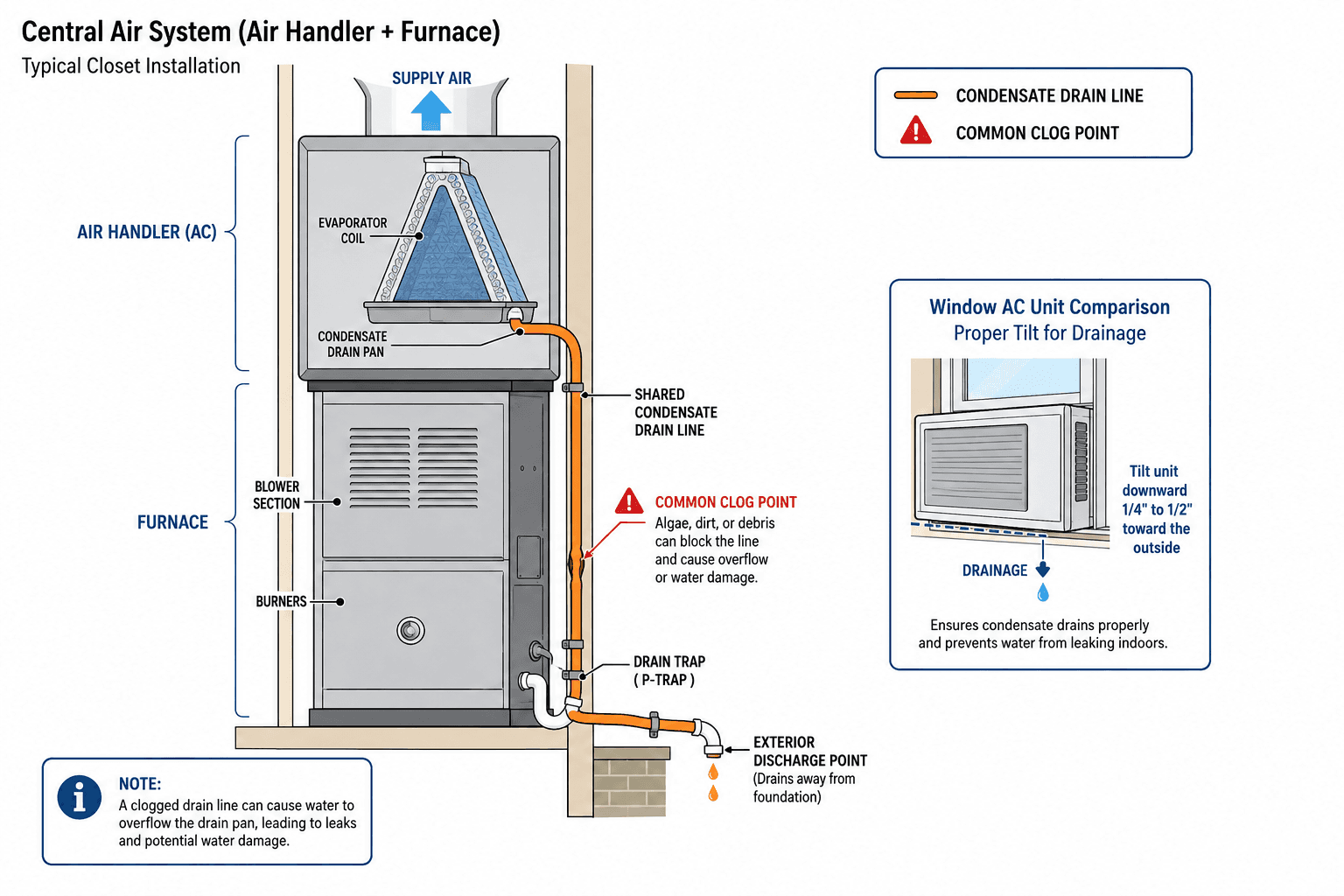
The window-unit tilt shown above applies to most units — but check your manual first. Many newer models are built to drain while sitting level, and some manufacturers specifically say not to tilt them.
Which one do you have?
The cause is genuinely different by unit type — a fix that works on a window unit will not touch a clogged central-AC drain line.
Central AC
Common, usually simple- —The condensate drain line is clogged — algae and mold build up inside it over time, which is by far the most common cause
- —The drain pan has rusted through or cracked, on an older unit
- —The condensate pump has failed, on a system that uses one to lift water uphill to a drain
What to do: Find the drain line where it exits outside — usually a white PVC pipe near the outdoor unit. If nothing drips from it while the AC runs, it is clogged, not leaking at the source.
Window unit
Usually a leveling problem- —The unit is not tilted slightly toward the outside — most window units are designed to drain outward, and a level or inward-tilted unit sends condensate back into the room instead
- —The drain hole on the base pan is blocked with debris
- —Ice has formed on the coil and is now melting faster than the pan can drain
What to do: Check the tilt first — but check your manual before adjusting anything. Many newer units are designed to sit level, and some manufacturers specifically say not to tilt them.
Portable unit
Usually just maintenance- —The internal water reservoir is full and needs emptying — the most common cause by far on units without a continuous drain hose
- —The drain hose, if fitted, is kinked or not angled downward for its full length
- —The unit is on an uneven floor, tilting it enough to spill from the internal tank
What to do: Check whether your model self-evaporates or needs manual emptying. Most portable units need the tank emptied every few days in humid conditions.
Furnace (high-efficiency)
Read the note below- —A clogged condensate drain line — high-efficiency furnaces produce condensate too, and often share a drain line with the AC coil above them
- —A cracked or disconnected condensate trap
- —A blocked or improperly sloped drain hose from the furnace itself
What to do: If the leak only happens when the AC is running, not the furnace, the shared drain line is almost certainly the cause — see below.
Why your furnace leaks water only when the AC runs
In a lot of homes, the furnace and the air conditioner are not separate systems as far as condensate is concerned. The AC evaporator coil often sits directly on top of, or right beside, the furnace inside the same air handler cabinet — and the two frequently share a single drain line out to the exterior.
When that shared line clogs, the water backs up and shows up around the furnace, even though the furnace itself did nothing wrong. It is one of the most commonly misdiagnosed leaks in a home — people call about the furnace, and the actual problem is a drain line it merely happens to share.
Step-by-step: clearing a clogged condensate line
This is the fix for the most common cause on central systems, and the same fix for a furnace leaking because of a shared line. Two methods — start with the vacuum.
Method 1: wet/dry vacuum from the outside
- 1Turn the system off at the thermostat and the breakerDo not leave it running while you work on the drain.
- 2Find the drain line where it exits outsideUsually a white PVC pipe near the outdoor condenser unit, terminating a few inches above the ground.
- 3Seal the vacuum hose over the pipe endA rag or duct tape wrapped around the joint makes the seal — the suction only works if it is reasonably airtight.
- 4Run the vacuum for a couple of minutesYou are pulling the clog backwards out of the line. Expect dirty water and sludge in the vacuum canister.
- 5Check the indoor drain panIf standing water there has started draining, the clog cleared. If not, try method 2.
Method 2: flush from the access point
- 1Locate the access point near the indoor unitUsually a T-shaped fitting with a removable cap on the drain line, close to the air handler.
- 2Remove the cap and check for standing waterWater sitting in the line confirms a blockage downstream.
- 3Flush with distilled vinegarRoughly a cup poured into the access point. Vinegar breaks down the algae growth that causes most clogs.
- 4Wait, then flush with waterGive it half an hour, then follow with plain water to carry the loosened debris out.
- 5Replace the cap and restore powerWatch the outside discharge point while the system runs to confirm water is flowing again.
Already have water damage? What to check
AC leaks are easy to miss because the unit is often in an attic, a closet, or above a ceiling. By the time it is visible, it has usually been going a while.
Renting? What you can and cannot fix yourself
Responsibilities vary by lease and by local law, so treat this as practical guidance rather than a legal answer — but the split is usually along these lines.
Usually reasonable to handle
- — Emptying a portable unit's reservoir
- — Clearing debris from a window unit's drain hole
- — Reporting the leak promptly, in writing
Usually the landlord's
- — Anything involving the building's central HVAC
- — A failed condensate pump or cracked drain pan
- — Resulting damage to ceilings, walls, or flooring
- — Repeated clogs that keep coming back after clearing
Document it before you do anything else
Photos of the leak and any damage, the date you first noticed it, and a written maintenance request rather than a verbal one. If the leak later turns into a dispute about who pays for damage, a dated written record is the thing that settles it.
Does it actually matter, or can it wait?
EPA guidance recommends drying wet materials within 24 to 48 hours specifically because mold can begin growing in that window. It is a planning benchmark, not a hard trigger, but it is the number worth acting inside of rather than testing.
If your air handler is in an attic, treat a leak as more urgent than the same leak from a ground-floor closet. Attic leaks are easy to miss until they show up as a stain or sag on the ceiling below — by which point real damage has already happened.
Water damage is water damage regardless of source. The average US water-damage insurance claim runs $13,954 — a condensate leak that soaks drywall or subfloor for weeks is not exempt from that math just because it started small.
DIY, or call an HVAC tech?
Reasonable to handle yourself
- — Clearing a clogged drain line, using either method above
- — Re-leveling a window unit, if your manual says it should be tilted
- — Emptying a portable unit's reservoir on schedule
- — Clearing debris from a window unit's drain hole
Call a technician
- — A clog that comes back after clearing it
- — Standing water inside the unit itself, not just the drain pan
- — A failed condensate pump
- — Ice on the coil, which points to a refrigerant or airflow problem
Catch it before it reaches the ceiling
An AC leak is the strongest case for a sensor of any appliance in the house — precisely because the unit is usually somewhere you never look.
Where it actually goes
In the secondary drain pan under the air handler, if your system has one, or directly on the floor beneath it. That pan exists specifically to catch an overflow — a sensor sitting in it tells you the moment the primary drain has failed.
Why attics change the maths
A leak in a ground-floor closet gets noticed in hours. The same leak in an attic gets noticed when the ceiling below stains — potentially weeks later, with the damage already done. If your air handler is in an attic, a sensor is worth more than it is anywhere else in the house.
Which system actually fits this leak
An air handler leak is the classic case for a sensor rather than a valve: the water is coming from condensate, not your supply line, so a main-line shut-off will not stop it. What you want is to find out before the ceiling stains.
The right shape of product for an attic air handler — cheap enough to place several, loud enough to notice, and nothing to plumb in.
Straps to your meter and watches whole-home flow. Useful for the supply-side leaks a condensate sensor will never see.
For supply-line protection alongside your condensate sensors — it cannot stop a condensate leak, and no main-line valve can.
Frequently asked questions
That points squarely at the condensate drain line. Central AC removes humidity from the air as it cools, and that water has to go somewhere — normally down a drain line to the outside. Algae and mold build up inside that line over time and eventually block it, so the water backs up and finds another way out, usually through the drain pan overflow. It only shows up when the system is running because that is the only time it is actually producing condensate.
In many systems, the furnace and the AC evaporator coil sit in the same air handler and share a single condensate drain line — the coil is often mounted directly above or beside the furnace. If that shared line clogs, the water has to come from somewhere, and it commonly shows up around the furnace even though the furnace itself is not the source. This is one of the most misdiagnosed HVAC leaks: people replace or service the furnace when the actual problem is the drain line the two systems share.
For a short time while you diagnose it, generally yes — a condensate leak is not usually a safety hazard the way a refrigerant or electrical problem would be. But keep water away from any electrical components, and don't let it run long enough to soak drywall, subfloor, or a ceiling below the unit. If the unit is in an attic, treat it as more urgent — attic leaks often go unnoticed until there is visible ceiling damage.
EPA guidance recommends drying wet materials within 24 to 48 hours specifically because mold can begin growing in that window on damp drywall, wood, or insulation. That is a planning benchmark, not an exact trigger — it depends on temperature and humidity — but it is the number worth planning around rather than waiting to see what happens.
Often, yes. The common DIY approach is to locate the drain line access point (usually a T-shaped fitting near the indoor unit) and clear it with a wet/dry vacuum from the outside termination point, or flush it with a cup of distilled vinegar to break down algae growth. If the clog keeps coming back, or you find standing water inside the unit itself, that points to something beyond a routine clean and is worth a technician visit.
The commonly cited range is a quarter to a half inch of drop toward the outside across the depth of the unit — enough for gravity to carry condensate out the rear drain holes, not so much that it stresses the mounting or unbalances the internal drain pan. But check your manual first: many newer window units, particularly inverter and U-shaped models, are designed with internal drainage that works with the unit level, and some manufacturers explicitly instruct not to tilt them. If your unit is one of those and it is leaking, tilting it is not the fix.
That depends on your lease and your local tenancy laws, so this is not legal advice — but practically, clearing a blocked drain line on a unit you control is usually reasonable tenant maintenance, while anything involving the building's central HVAC, a failed condensate pump, or resulting water damage is normally the landlord's. The useful move either way is to document it early: photos, the date you noticed it, and a written maintenance request rather than a verbal one.
Sources & References
- 1Mold remediation guidance — drying window after water exposureUS Environmental Protection Agency, corroborated by CDC and OSHA guidance · accessed 2026
EPA guidance recommends drying wet building materials within 24 to 48 hours specifically because mold can begin growing on damp drywall, wood and insulation in that window. This is a planning benchmark, not an exact trigger — EPA's own guidance notes it depends on temperature and humidity, and mold may occur even inside the window or may not occur outside it.
- 2Insurance Information Institute (Triple-I), from ISO data · 2018–2022 accident years
Source for the average water damage and freezing claim ($13,954) and for water damage's share of all homeowners claims.
Figures on this page are quoted from the sources above. Where a number is widely repeated online but could not be traced to a primary source, it is not published here. Found something wrong? Tell us and we will correct it.

Written by
SK Kutubuddin
Founder & editor, LeakCheckPro
A former aviation professional with over two decades of hands-on expertise in aero-engine maintenance, inspection, and tool management.
He is not a licensed plumber. Reviews here are built from manufacturer documentation, published standards and independent testing where it exists, and every figure is cited. Nothing on this site claims a hands-on test that did not happen.