
Basement Water Leak?
Check This Before You Panic
When it leaks matters as much as where. One pattern points at a cheap fix. The other points at something more serious. Here's how to tell which one you have.
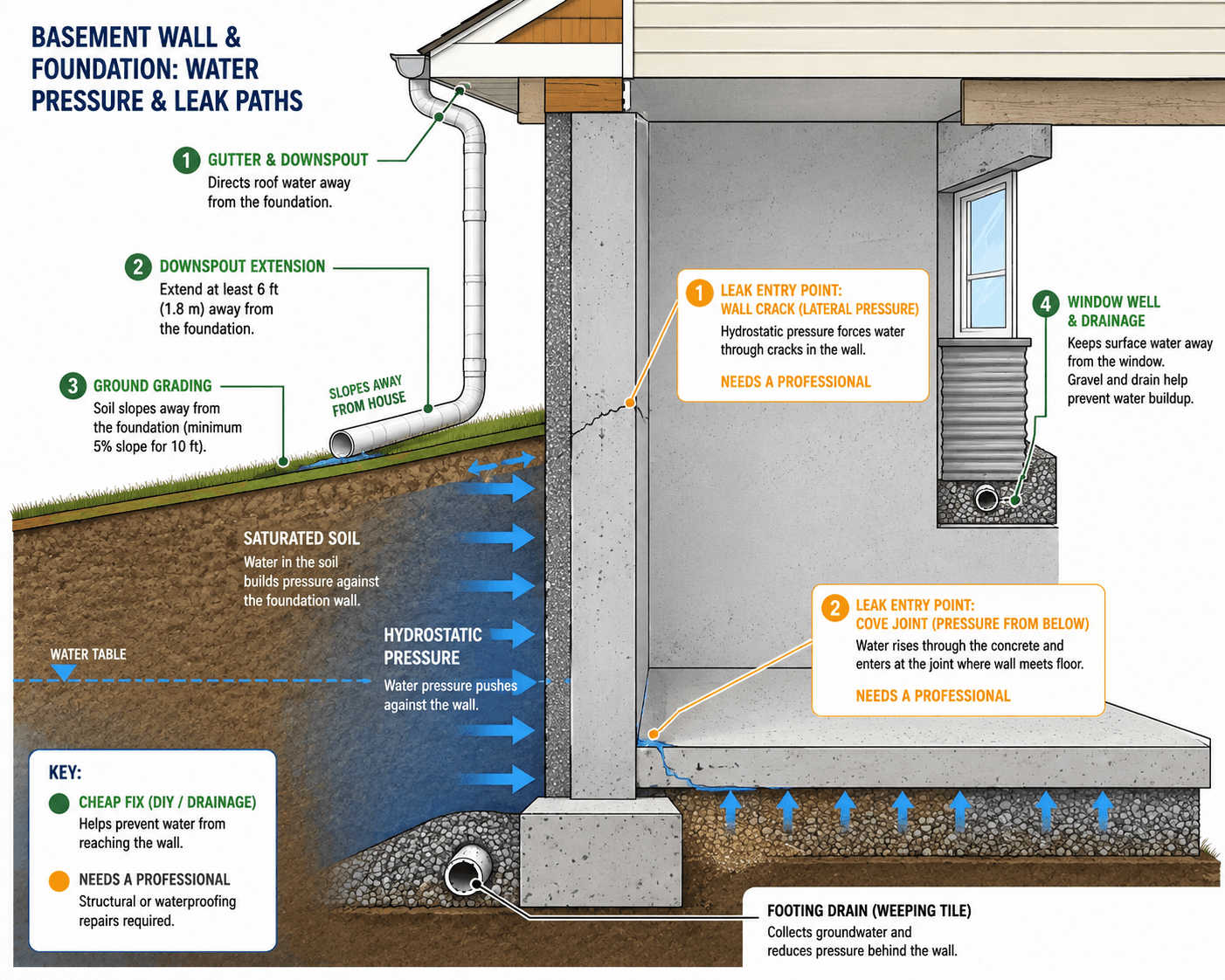
The green items are the drainage fixes worth trying first. The orange entry points are what you are trying to keep water away from — and, as the section below explains, drainage pressure is often what created them.
Does it only leak after heavy rain?
This single question does most of the diagnostic work. Answer it before you call anyone.
Yes — only during or right after storms
Usually cheap to fix- —Clogged gutters or downspouts dumping water right beside the foundation
- —The ground sloping toward the house instead of away from it
- —A window well filling up faster than it can drain
What to do: Start outside, not inside. See the drainage fixes below before assuming you need foundation work.
No — it's persistent, or unrelated to rain
Worth a proper look- —Ongoing groundwater pressure against the foundation, not tied to a specific storm
- —An existing crack that has widened enough to leak regardless of conditions outside
- —Water entering along the floor-wall joint (the cove joint) from underneath the slab
What to do: Drainage fixes alone likely won't solve this. Worth a waterproofing contractor's assessment.
Drainage pressure is often what caused the crack
It's tempting to treat “drainage problem” and “cracked foundation” as two unrelated diagnoses — one cheap, one scary. They're often connected. Water pooling against the foundation from poor drainage builds up hydrostatic pressure, and over time that pressure is a common reason foundations crack in the first place.
That's why fixing drainage still matters even once a crack has been sealed — the pressure that caused it doesn't disappear on its own, and an unaddressed drainage problem can eventually produce a new crack somewhere else.
Wall crack or floor crack? Different mechanism
Wall leaks
Usually straightforward: hydrostatic pressure from soil against the wall, pushing water through a crack or through porous concrete. This is the pattern most directly tied to drainage and grading.
Floor leaks, especially at the edge
Water appearing along where the floor meets the wall — the cove joint — is more often pressure pushing UP from under the slab, not sideways through a wall. Surface sealant tends not to hold here, because the underlying pressure is still there. This one usually needs interior drainage, not a patch.
The cheap fixes, if you're in the “after rain” category
All four are the green items in the diagram above. Start here before spending anything on foundation work.
Clean them first — an overflowing gutter dumps water right beside the foundation instead of carrying it away. This is the cheapest thing on the list and the one most often skipped.
Guidance clusters around a minimum of about 6 feet from the foundation, with 10 feet or more considered better — and homes with basements belong at the farther end of that range.
Rigid or corrugated pipe holds position better than splash blocks, which get knocked out of place. Check that the discharge point is actually lower than the entry point, with a clear path away — otherwise the extension just moves the puddle a few feet.
The International Residential Code (Section R401.3) sets the widely-adopted standard: the ground should fall at least 6 inches within the first 10 feet out from the foundation wall — roughly a 5% slope, and steeper than most people expect.
That is a minimum, not a target. Check it with a string and a level. Soil settles and erodes over time, so a slope that was correct at construction can drift back toward flat — worth rechecking after landscaping work or a season of heavy rain. Where a lot line or wall makes the full fall impossible, the code allows swales or drains to achieve the same result.
A window well that fills faster than it drains is a direct path for water to sit against the foundation. Check that the well has a working drain and isn't packed with leaves or debris. A cover keeps most of the rain out in the first place.
What repair actually costs — in tiers
Quoted prices for basement waterproofing vary enormously, which is exactly why a single number is not useful. What is useful is knowing which tier your problem sits in, because that is what drives the difference.
Tier 1 — drainage fixes
Gutter cleaning, downspout extensions, regrading, a window well cover. Mostly your own labour plus materials, and the tier that resolves most rain-triggered leaks. If your leak is in the “only after heavy rain” category, this is where to start and quite possibly where to stop.
Tier 2 — single-point repair
Crack injection or sealing one specific entry point. A contractor job, but a contained one — priced per crack rather than per foot of wall. Worth remembering that this treats the symptom: if drainage pressure caused the crack, it can produce another one elsewhere.
Tier 3 — whole-perimeter systems
Interior drainage with a sump system, or exterior excavation and waterproofing. This is the expensive tier by a wide margin, and the one persistent non-rain-related leaks and cove-joint leaks usually land in. Exterior excavation costs considerably more than interior drainage because of the digging involved.
We are deliberately not quoting dollar figures here. Basement waterproofing pricing depends heavily on region, access, wall length and how much excavation is involved, and a number that looks authoritative but does not match your situation is worse than no number. Get two or three local quotes and use the tiers above to sanity-check what you are being quoted for.
Catching it before it becomes obvious
A basement is the easiest room in the house for a leak to go unnoticed — particularly a finished one, where the water reaches carpet or stored belongings before anyone sees it.
Where a sensor goes
Along the base of the wall at the lowest point of the floor, and beside any spot that has leaked before. If you have a sump pump, one in the sump pit tells you if the pump has failed — which is its own flooding scenario, separate from wall seepage.
What to check by eye
Efflorescence — the chalky white mineral deposit left behind when water moves through concrete and evaporates — is a reliable sign water has been coming through, even if the wall is dry when you look at it. Staining along the cove joint tells the same story.
Water from the ceiling, or a specific pipe?
This page covers water intruding from outside — through walls, floors, or cracks. A basement ceiling leak is almost always plumbing from the floor above, not foundation water. A leak clearly from a specific pipe running through the basement is a supply-line problem, not a foundation one. Different cause, different fix.
Which system actually fits this leak
Basements are where the two kinds of leak detection genuinely diverge. Groundwater and foundation seepage need sensors and a sump alarm — no valve on your supply line will stop water coming through a wall. A burst supply pipe down there is the opposite case.
Cheap enough to cover the sump pit, the far corner and the foundation wall at once. Long range helps in a basement where WiFi is weak.
Its LoRa radio was built for exactly this — thick walls and distance from the router are where WiFi sensors quietly stop reporting.
For the burst-supply-pipe case: automatic shut-off while nobody is down there to notice.
Frequently asked questions
Not necessarily, and this pattern is actually useful information. A leak that shows up only during or right after heavy rain usually points to surface water overload — short downspouts, clogged gutters, poor grading, or a window well filling up — rather than a structural problem with the foundation itself. A leak that shows up regardless of rain, or that never really stops, points more toward persistent groundwater pressure or an existing crack. The pattern is the first diagnostic clue, before you spend anything.
The immediate risks are mold and structural damage, not something acute like a gas or electrical hazard. EPA guidance recommends drying wet materials within 24 to 48 hours specifically because mold can begin growing in that window — a basement is exactly the kind of space where a leak can go unnoticed for a while, which is what makes that window matter. Left unaddressed, it's ordinary water damage: the average US water-damage insurance claim runs $13,954.
Often both, in that order. Water pooling against the foundation from poor drainage creates hydrostatic pressure, and over time that pressure is a common cause of the crack in the first place — not a separate, unrelated problem. That's part of why fixing the drainage matters even after a crack has been sealed: the pressure that caused it doesn't go away on its own.
Often, yes. Wall leaks are usually straightforward hydrostatic pressure pushing through a crack or porous concrete. Floor leaks, especially along the edge where the floor meets the wall (called the cove joint), are more often water pushing up from under the slab. Surface patching tends not to hold on this type of leak, because the pressure underneath doesn't go away — it usually needs interior drainage rather than a sealant.
That's a different problem, and this page isn't the right place for it — a basement ceiling leak is almost always plumbing from the floor above (a bathroom, kitchen, or laundry line), not water intruding from outside. Trace it to the fixture directly above where the water appears.
The International Residential Code (Section R401.3) sets the widely-adopted minimum: the ground should fall at least 6 inches within the first 10 feet measured out from the foundation wall — that works out to roughly a 5% slope, which is noticeably steeper than most people expect. It is a minimum, not a target, and some drainage specialists recommend more where site conditions allow. Where a lot line, wall, or other physical barrier makes that impossible, the code allows swales or drains to achieve the same result instead.
Guidance clusters around a minimum of about 6 feet from the foundation, with 10 feet or more considered better — and homes with basements sit at the farther end of that range, since water against a below-grade wall is exactly the pressure problem you are trying to avoid. Rigid or corrugated extension pipe holds position better than splash blocks, which tend to get knocked out of place. One thing worth checking: the discharge point needs to be lower than the entry point, with a clear path away, or the extension just moves the puddle a few feet.
A footing drain, sometimes called weeping tile, is perforated pipe laid in gravel alongside the foundation footing. It collects groundwater before it builds pressure against the wall and carries it away. Most homes built in the last several decades have one; older homes often do not, or have one that has silted up over the years. You generally cannot inspect it without excavation, which is part of why persistent leaks — as opposed to rain-triggered ones — usually need a professional assessment rather than a DIY fix.
Sources & References
- 1Basement water leak causes — drainage vs. structuralCross-checked against 7 independent basement-waterproofing and foundation-repair sources · accessed 2026
A leak that appears only during or after heavy rain points to surface water overload (short downspouts, clogged gutters, poor grading, window wells) rather than a structural fault. Persistent hydrostatic pressure from that same drainage failure is a documented, common cause of foundation cracks themselves, not a separate problem. Grading guidance across sources ranges roughly 1 inch of drop per foot to about 5% slope for the first several feet from the foundation — stated as a rule of thumb, not a single precise figure, since sources vary.
- 2Foundation site drainage and grading requirementsInternational Residential Code Section R401.3, cross-checked against multiple drainage and foundation sources · accessed 2026
IRC R401.3 requires lots to be graded so surface water drains away from foundation walls, with the grade falling a minimum of 6 inches within the first 10 feet measured out from the wall, equivalent to roughly a 5 percent slope. Where a lot line, wall or other physical barrier prevents that fall, the code allows drains or swales to achieve equivalent drainage. This is a minimum rather than a target, and some drainage specialists recommend a steeper slope where site conditions permit. Downspout guidance across sources clusters at a minimum of about 6 feet of extension from the foundation, with 10 feet or more preferred, and homes with basements at the farther end of that range.
- 3Mold remediation guidance — drying window after water exposureUS Environmental Protection Agency, corroborated by CDC and OSHA guidance · accessed 2026
EPA guidance recommends drying wet building materials within 24 to 48 hours specifically because mold can begin growing on damp drywall, wood and insulation in that window. This is a planning benchmark, not an exact trigger — EPA's own guidance notes it depends on temperature and humidity, and mold may occur even inside the window or may not occur outside it.
- 4Insurance Information Institute (Triple-I), from ISO data · 2018–2022 accident years
Source for the average water damage and freezing claim ($13,954) and for water damage's share of all homeowners claims.
Figures on this page are quoted from the sources above. Where a number is widely repeated online but could not be traced to a primary source, it is not published here. Found something wrong? Tell us and we will correct it.

Written by
SK Kutubuddin
Founder & editor, LeakCheckPro
A former aviation professional with over two decades of hands-on expertise in aero-engine maintenance, inspection, and tool management.
He is not a licensed plumber. Reviews here are built from manufacturer documentation, published standards and independent testing where it exists, and every figure is cited. Nothing on this site claims a hands-on test that did not happen.