
Think You Smell Gas?
Read This First
If you smell a strong gas odor right now:
- 1.Leave immediately — don't stop to find the source.
- 2.Don't operate anything that could spark — no light switches, phones, flashlights, or appliances, on or off, while inside or near the smell.
- 3.Get everyone and any pets out, then call your gas utility's emergency line or 911 — from outside, or a neighbor's phone.
- 4.Don't go back in until a professional says it's safe.
This is the standard guidance from every major gas utility, and it doesn't change based on how the leak started. Act first, ask questions after.
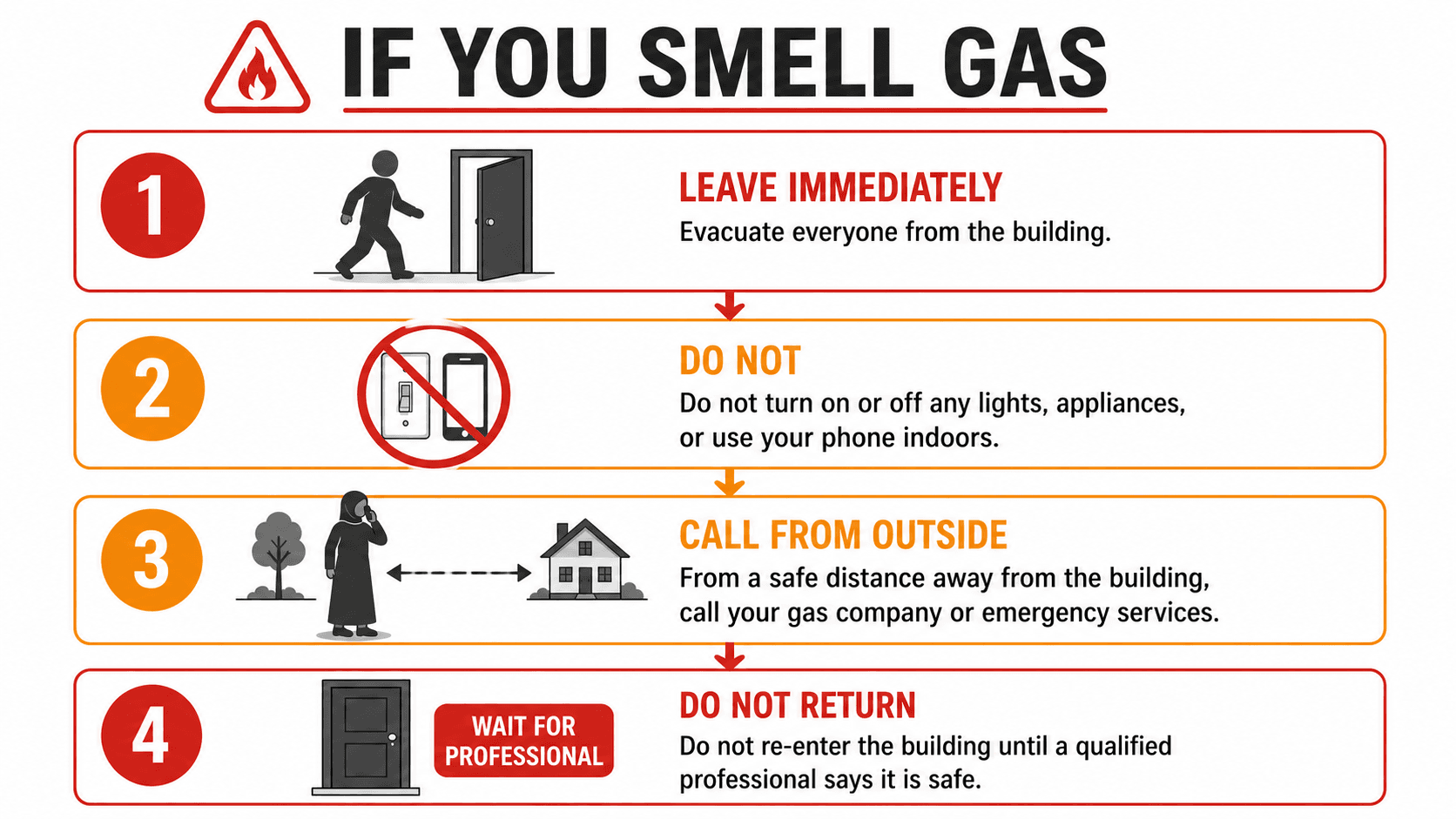
One thing the steps above make explicit that is easy to miss at a glance: make that call from outside the building, or from a neighbour's phone — not from indoors.
Why gas smells like rotten eggs — and why that can fail you
Natural gas and propane are naturally odorless. Utilities add a sulfur-based compound called mercaptan specifically so a leak is detectable before it becomes dangerous — the smell you notice is the additive, not the gas itself.
Smell alone isn't a complete safety system
Some utilities specifically warn about “odor fade” — conditions, more common in new pipe, where the additive can diminish before it reaches you. Cold symptoms or a reduced sense of smell can also mean you miss it. That is part of why a dedicated combustible gas detector is worth having as a backup, not a replacement, for your nose.
Signs beyond the smell
Gas leak or carbon monoxide? Different hazard, different detector
A raw gas leak is fuel escaping before it has been burned at all — the danger is fire, explosion, and at high enough concentration, oxygen displacement. Carbon monoxide is a completely different gas: a byproduct of incomplete combustion, produced when a furnace, water heater, generator, or gas stove burns fuel without enough oxygen. It is odorless and colorless, and it works by binding directly to your blood, not by displacing the air you breathe.
Because the symptoms of both can look similar — headache, dizziness, nausea, confusion — people assume one device covers both. It doesn't. A carbon monoxide detector will not reliably sense a raw gas leak, and a combustible gas detector is not a substitute for CO protection near sleeping areas. If you have gas-burning appliances, you need both, and it's worth checking exactly what any device you buy actually senses.
Common causes of a home gas leak
Types of gas detection, in general terms
Since smell alone isn't a complete safety system, it's worth knowing what the categories actually are and what each is for. These are descriptions of how the technology works, not recommendations — see the note at the end.
Fixed combustible gas detectors
Plug-in or hardwired units that monitor continuously for gas in the air. Which fuel you have changes where the unit belongs, and this matters more than it sounds.
Natural gas is lighter than air, so a leak rises and collects at the highest point of a room — NFPA 715, the standard covering fuel-gas detection equipment, calls for alarms within 12 inches of the ceiling for natural gas. Propane is heavier than air and does the opposite, pooling near the floor, so propane units belong low. One practical consequence worth knowing: a plug-in model is limited to outlet height, which can be too low to catch a natural gas leak promptly. Confirm which fuel your home actually uses, and follow the mounting height in the manual — sensor calibration is tuned to a specific sampling position.
Portable and handheld detectors
Battery units with a probe or wand, used to trace a suspected leak to a specific fitting rather than to monitor a room. These are the tool a technician uses to pinpoint a source, and the category most useful for checking connections after appliance work.
Leak detection solution (the soap test)
A liquid brushed onto a fitting that bubbles where gas is escaping. It is the oldest method and still a standard one, requiring no power or calibration — but it only tests the specific joint you apply it to, so it confirms or clears one connection at a time rather than finding an unknown leak.
Carbon monoxide detectors are a separate device
Worth repeating because it is the most consequential mix-up on this page: a CO detector will not reliably sense a raw gas leak, and a combustible gas detector is not CO protection. If you have gas-burning appliances, those are two different jobs. Combination units exist — if you buy one, check specifically that it senses both, rather than assuming from the name.
Looking for a specific detector to buy?
We haven't tested gas or CO detectors, so this page describes the categories rather than naming products — we'd rather say that than publish picks we can't stand behind. Our tested reviews currently cover smart water leak sensors; if that's also on your list, see our comparison of smart water monitors.
Frequently asked questions
A large enough leak is genuinely dangerous while you sleep, mainly through fire and explosion risk and, at high enough concentration, by displacing the oxygen in the air. But the specific fear most people mean by this question — dying quietly, in your sleep, with no warning — is more characteristic of carbon monoxide poisoning than a raw gas leak. CO binds directly to your blood's oxygen-carrying cells, and the CDC notes that people who are asleep can be affected before they ever develop symptoms that would wake them. If you have gas-burning appliances, a working carbon monoxide detector near sleeping areas is the specific protection for that scenario — a gas leak's odorant is what protects you from the other one.
No, and this is one of the most common mix-ups in home safety. Carbon monoxide is a byproduct of incomplete combustion — it's produced when a furnace, water heater, generator, or gas stove burns fuel without enough oxygen. A raw natural gas leak is unburned fuel escaping before any combustion happens at all. They're different gases, detected by different sensors. A CO detector is not a substitute for the odorant that warns you of a gas leak, and it will not reliably sense one.
Natural gas and propane are naturally odorless, so utilities add a chemical called mercaptan (or a similar sulfur-based compound) specifically so leaks are detectable — the rotten-egg or sulfur smell you're smelling is the additive, not the gas itself. Federal regulation requires it to be detectable well before concentrations become dangerous. That said, some utilities warn of "odor fade," where the additive can diminish under certain pipe conditions — which is exactly why smell alone isn't considered a complete safety system, and why combustible gas detectors exist as a backup.
A hissing or whistling sound near a gas line or appliance, dirt or dust blowing or swirling near the ground with no wind, bubbles appearing in standing water outside, a dry patch of grass in an otherwise healthy lawn, or houseplants dying for no clear reason can all be signs, even without a strong smell.
If the smell is faint and you can trace it to one obvious source — a stove burner left slightly open, for example — turning it off is reasonable. If the smell is strong, you can't immediately identify the source, or you're at all unsure, the right move is to leave and call from outside, not investigate further. This isn't overcaution — it's the same guidance every major utility gives.
Sources & References
- 1Natural gas odorization and emergency response guidanceCross-checked across multiple gas utilities (PSEG, NW Natural, Citizens Energy, York County Natural Gas Authority) and 49 CFR 192.625 · accessed 2026
Natural gas and propane are naturally odorless; utilities add a mercaptan-family odorant specifically so leaks are detectable before reaching dangerous concentrations, a requirement under federal regulation 49 CFR 192.625. Some utilities document a phenomenon called odor fade, where the additive can diminish under certain pipe conditions, which is why a dedicated detector is recommended as a backup to smell. The standard emergency procedure (evacuate, avoid anything that could spark, call from outside, do not re-enter until cleared) is consistent across every utility checked.
- 2Carbon monoxide poisoning — symptoms and mechanismUS Centers for Disease Control and Prevention, cross-checked against Cleveland Clinic and Johns Hopkins Medicine · accessed 2026
CDC: common CO poisoning symptoms are headache, dizziness, weakness, upset stomach, vomiting, chest pain, and confusion, often described as flu-like. CO is an odorless, colorless byproduct of incomplete combustion (furnaces, water heaters, generators, gas stoves), distinct in mechanism from a raw, unburned gas leak: CO binds directly to hemoglobin, while a gas leak's primary hazards are fire/explosion and, at high concentration, oxygen displacement. People who are asleep can be affected by CO before symptoms would wake them.
- 3Combustible gas detector mounting height by fuel typeNFPA 715 (Standard for the Installation of Fuel Gases Detection and Warning Equipment), cross-checked against multiple industrial and residential gas detection sources · accessed 2026
Natural gas (methane) is lighter than air and collects at the highest point of a room; NFPA 715 calls for natural gas alarms to be installed within 12 inches of the ceiling. Propane is heavier than air, pools at floor level, and its detectors belong low in the room, with sensor calibration differing between the two fuels. A practical consequence: plug-in detector models are limited to outlet height, which can be too low to detect a natural gas leak promptly. Manufacturer mounting guidance should be followed because sensor calibration is tuned to a specific sampling position.
Figures on this page are quoted from the sources above. Where a number is widely repeated online but could not be traced to a primary source, it is not published here. Found something wrong? Tell us and we will correct it.

Written by
SK Kutubuddin
Founder & editor, LeakCheckPro
A former aviation professional with over two decades of hands-on expertise in aero-engine maintenance, inspection, and tool management.
He is not a licensed plumber. Reviews here are built from manufacturer documentation, published standards and independent testing where it exists, and every figure is cited. Nothing on this site claims a hands-on test that did not happen.